It’s been a while since my last post, as usual. I’ve started to scale back my design work for various reasons. Also, it’s become economically unviable to have circuit boards made and assembled, primarily due to the idiocy of the current tariffs, component shortages and price increases. And a lot of people don’t have disposable income these days anway.

I’m going to sell off what remains of my current stock of boards. Here’s what’s left:

ASR-10 SCSI
EPS-16 SCSI and Flash Bank
Prophet VS CEM5530 module and I-626 keyboard scanner
Dynacord ADS/ADD-Two memory
OB-Mx two voice board (coming soon)
Sequential Prophet 3000 memory expansion and I-627B adapter (for rev A machines)

People often ask me to share my designs, gerber files, schematics, etc. I often get questions like this:

Can you share the schematics for this project? I promise I won’t distribute them!
Can I have the source code for project xyz
Can you open source this project? Everyone would really appreciate it!
Can I get the gerber files for a board, I only want to make a few for myself
Can I collaborate on this project, I have some great ideas about features…
Will you allow me to make this board under license, to avoid tariffs in the EU (or wherever)

The answer to all of these is no. I’ve invested hundreds of hours researching and building these projects, and I don’t have the time or interest to answer emails about how to get boards made, where to buy components, and what to do when the board doesn’t work. The majority of people who ask for design files have no clue about what they are getting into. I know this seems harsh. But after having to repair 90% of the DSS-1 upgrades done by customers, I can safely say that most people are not up to the challenge. I would rather provide a complete, tested and working product that people can install without having to worry if it’s going to damage their instrument or spend hours trying to troubleshoot problems.

And I’m not interested in collaboration. The few times I’ve done it, it’s been a disaster, mostly because of peoples’ inexperience and unrealistic expectations. Maybe I’m just hard to work with, and I’m fine with that.
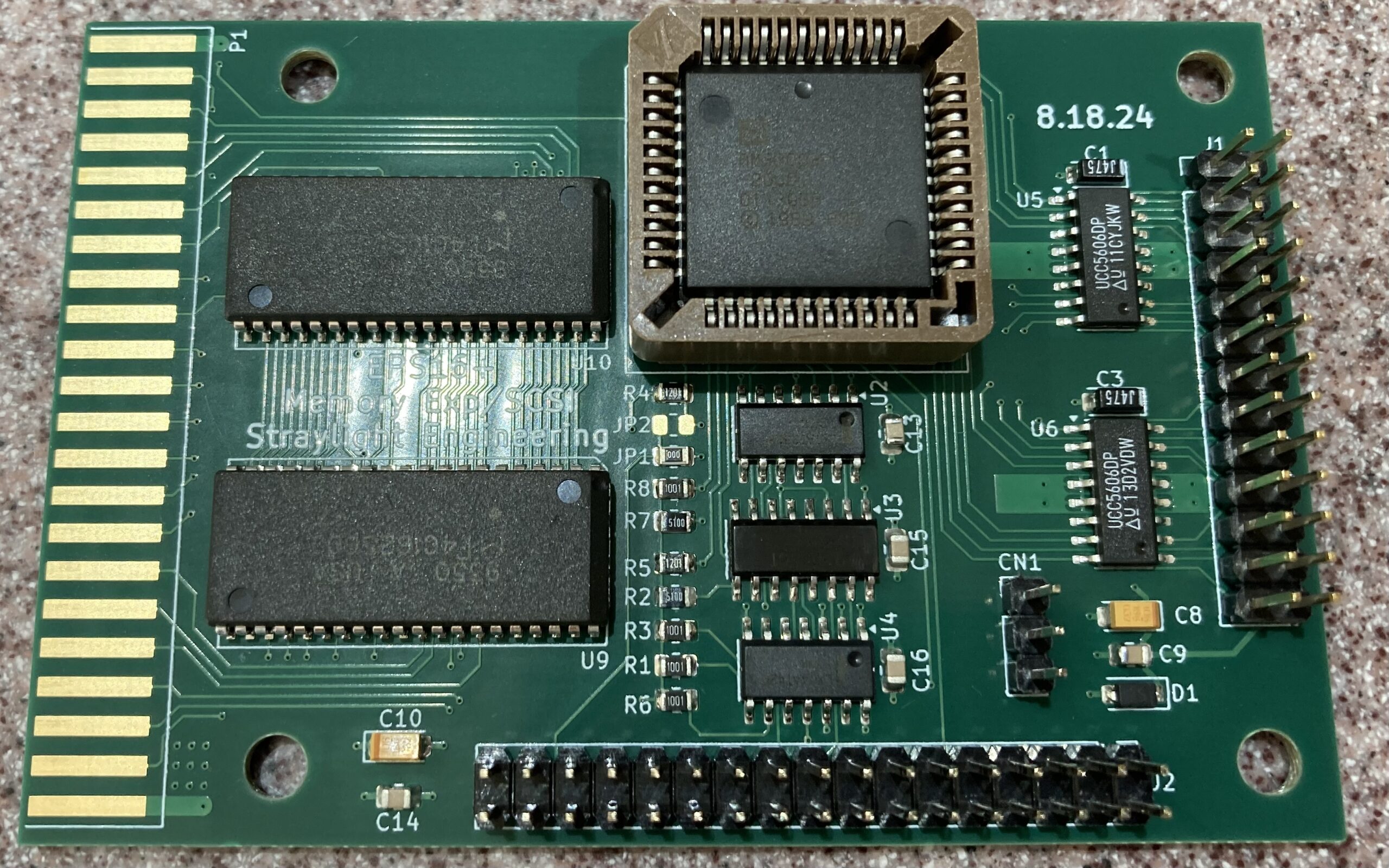
I haven’t had much to post about in a while. As usual, I haven’t had the time or motivation to work on anything new. However, I did manage to churn out a prototype of a board that combines the memory and SCSI expansion for the EPS16. Without further ado:

EPS-16 prototype memory/SCSI board

It’s in the testing stages right now. I don’t have a price set for it or when it will be available. So far I haven’t run into any issues. It uses two 256kx16 memory IC’s to save space. Also, I used active SCSI termination, the same as the ASR-10 SCSI board.

I did find out I had a batch of defective SCSI controllers which kept giving “file operation error” messages. A bit of background: the 33C93 SCSI controller was originally manufactured by Western Digital. It went through eight revisions, and the last one is what the AMD version is based on. Revisions earlier than this caused problems. I suspect that I got some re-packaged examples of these. Counterfeit IC’s are fairly common, unfortunately.

I’ve had many people ask me about the DI-10 digital interface for the ASR-10. The most common questions are:

Is it still available, and what’s the price?

Yes it’s still available, it’s $179.00 plus shipping. The 20-pin interface cable is different for the rack version, so please let me know which version (keyboard or rack) you have.

You mentioned that there are issues related to heat buildup in the ASR-10 rack which prevents use with the DI-10. Have you come up with a solution?

I did originally believe that to be the case, but now I am convinced that that was a one-off problem with a particular ASR-10 rack. I have had several people install the DI-10 in their ASR-10 racks, and there hasn’t been any problems (that I’ve been made aware of, anyway).

Older ASR-10’s tend to have more issues due to component differences and age of the machine itself. So it’s possible that you could encounter issues with the DI-10 (similar to the 44.1kHz problem with the SCSI board). Unfortunately there’s no way to know if the DI-10 will function properly until you install it.

Happy 2023! Hopefully this year will be better than the last few years have been.

As you’ve probably gathered, there hasn’t been much going on here. COVID has impacted the supply chain so it’s become more difficult and expensive to produce PCB’s. Therefore, I won’t be doing anything new for a while.

The DSS-1 upgrade is essentially discontinued. Since I was building them myself, I found it took around 7 hours to assemble, test, program, modify existing boards, etc. per kit. And there are some outstanding software issues which I don’t expect to be fixed anytime soon. So I’ve opted to focus my efforts on a different approach to the upgrade. However, I don’t expect to make progress on this (or the DSM-1) anytime soon.

I do still have the following:

ASR-10 SCSI and digital I/O, EPS-16 SCSI and Flash Bank, and CEM5530 replacement modules

In addition I will no longer offer repair services to equipment (other than the boards that I have sold).

The latest batch of DSS-1 kits are now sold out. The next run won’t be until the end of the year.

There is no waiting list, preorder, or deposit. I’ll announce the availability of the kits right here.

There are still ASR-10 SCSI and Digital I/O, as well as EPS-16 SCSI and Flash Bank. I also have the CEM5530 modules in stock.

I have 25 kits available immediately, the price is 300.00 plus shipping, first come, first served.

Now the details:

  • I no longer offer the LCD upgrade or floppy/combo drives. The LCD upgrade is fairly simple to do for most users. The procedure is detailed in the installation guide (under Downloads).
  • The KLM780, KLM782 boards (with attached KLM-1061) must be sent to me for modification. I discourage most users from trying to do the modification themselves, unless you are an experienced technician. It becomes difficult and costly to try and solve post-installation problems, especially if you are outside of the continental US.
  • There is no discount if you decide to install yourself. I’m offering free installation as an incentive to avoid further problems down the line.
  • A Gotek drive can be used with the upgrade, though it’s really only useful for importing disk images to the ‘native’ file based format. The same goes for a regular floppy drive. Once your floppy disks are imported, it isn’t really necessary. A better solution might be a 3.5″ multi card reader with additional USB port.
  • Please allow 2-3 weeks for modification.
  • LCD modules are available from several sources: eBay, BuyDisplay, Newhaven Display, Crystalfontz, Focus LCD’s, Ali Express, etc. You will need to consult the data sheet for pinout information. Some displays have a current limiting resistor on the display module itself, others don’t. OLED displays currently don’t work properly, but this is being worked on. The module format is 20×2 characters, 116mm x 37mm module size.
  • You will need to run the memory test BEFORE sending the boards in. If there are errors, the boards will require additional repairs, the cost will depend on parts and time. The upgraded DSS-1 won’t boot if it detects memory errors.

Version 4.06 fixes some system exclusive bugs and adds a few features.

You can download it here

Unzip the file, and put the two .bin files on the root level of a USB drive. Boot the DSS-1 into test mode holding the DATA A up/down buttons until you are asked to upgrade the OS. You may have to disconnect the USB device in the other port in order for the upgrade to be recognized.

Change list is included in the .zip file

Huge thanks to Jim Babb for continuing to support and enhance the DSS-1 after almost 35 years. For those of you who don’t know, Jim is the creator and programmer of the upgrade from 1987 along with Paul Kreter.

I’ve now gotten confirmation that issues working at 44.1kHz are present on the original Ensoniq SCSI boards. At this point it seems that certain manufacturers, or possibly batches of IC’s are the source of the problem.

The SCSI board provides circuitry to isolate the signals to and from the DAC and ADC to eliminate noise and jitter. One of these signals is the 256Fs clock (256x sample rate) which is over 11 Mhz. Because of the design of the circuit, IC’s that are slightly out of spec won’t work properly. This isn’t the whole source of the problem, though. Some ASR-10’s exacerbate this situation, which I believe may be related to the revisions of the custom chips on the main board. So a SCSI board with an out-of-spec IC may work fine in one machine and have problems in another.

I have suggested a possible fix to a user who has this issue, if the fix is successful I’ll post it.

I’ve finally resolved the issue that was affecting some ASR-10’s from working properly with the SCSI board.

I’ll do another post with an in-depth discussion of the issue, but I’m almost certain that this issue affects the original Ensoniq SCSI boards as well. Unfortunately I sold the only genuine SP-3 board that I owned, however I’m building a few of the older generation of the SCSI board (which is 99% the same as the Ensoniq board) to verify this.

If you have an original Ensoniq SCSI board in your ASR-10, you can check for the problem by toggling between 30kHz and 44.1kHz. At 44.1kHz you will hear distortion or audio artifacts. It doesn’t happen every time you switch, and it will sound slightly different each time.

If it turns out the problem does exist on the original SCSI boards, I will be offering a solution to fix it.